2.28. MedeA QSPR: Property Prediction Using Group Contributions
| download: | pdf |
|---|
2.28.1. Key Benefits of MedeA QSPR
- Determination of geometric descriptors for organic molecules
- Evaluation of thermodynamic properties (of organic compounds) based on Group contributions
- Rapid property calculation enabling screening of compounds and/or providing input conditions for molecular simulation Computational Characteristics
- Provides thermophysical properties (based on Joback’s Group Contribution method)
- Uses group contributions to compute properties based on correlations
2.28.2. Introduction
“MedeA QSPR: Property Prediction using Group Contributions” employs correlations to predict thermophysical properties based on the chemical groups that constitute an organic molecule. The number and type of groups and their contribution to each property, have been developed and described by Joback and Reid [1]. Only structural information of a chemical compound (a molecule) is used to calculate thermophysical and transport properties, by adding group parameters. This method uses a single group list for all eleven properties therefore allowing the calculation of all properties from a single analysis.
2.28.3. Molecular Descriptors
There are 42 molecular descriptors (i.e. groups) in the Joback & Reid method [1]. These molecular descriptors are listed below, along with a short description and the name of the “MedeA variable” that is associated with each descriptor. MedeA variables are useful when printing these quantities in user-defined tables, as part of a flowchart involving a QSPR stage.
| Descriptor | MedeA variable | Description |
|---|---|---|
| NC1 | qspr_NC1_calc | -CH3 non-ring groups |
| NC2 | qspr_NC2_calc | -CH2 non-ring groups |
| NC3 | qspr_NC3_calc | -CH non-ring groups |
| NC4 | qspr_NC4_calc | -C non-ring groups |
| NC5 | qspr_NC5_calc | =CH2 non-ring groups |
| NC6 | qspr_NC6_calc | =CH non-ring groups |
| NC7 | qspr_NC7_calc | =C non-ring groups |
| NC8 | qspr_NC8_calc | =C= non-ring groups |
| NC9 | qspr_NC9_calc | #CH non-ring groups |
| NC10 | qspr_NC10_calc | #C non-ring groups |
| NC11 | qspr_NC11_calc | -CH2 non-aromatic ring groups |
| NC12 | qspr_NC12_calc | -CH non-aromatic ring groups |
| NC13 | qspr_NC13_calc | -C non-aromatic ring groups |
| NC14 | qspr_NC14_calc | =CH aromatic ring groups |
| NC15 | qspr_NC15_calc | =C aromatic ring groups |
| NF1 | qspr_NF1_calc | F groups |
| NCl1 | qspr_NCl1_calc | Cl groups |
| NBr1 | qspr_NBr1_calc | Br groups |
| NI1 | qspr_NI1_calc | I groups |
| NO1 | qspr_NO1_calc | -O- groups in OH, in alcohols |
| NO2 | qspr_NO2_calc | -O- groups in OH, in phenol |
| NO3 | qspr_NO3_calc | -O- groups in ethers, nonring |
| NO4 | qspr_NO4_calc | -O- groups in ethers, ring |
| NO5 | qspr_NO5_calc | =O groups, nonring |
| NO6 | qspr_NO6_calc | =O groups, ring |
| NO7 | qspr_NO7_calc | =O groups in aldehydes |
| NO8 | qspr_NO8_calc | -O- groups in carboxylic acid groups |
| NO9 | qspr_NO9_calc | -O- groups in carboxylic ester groups |
| NO10 | qspr_NO10_calc | =O groups in other than NO1-NO9 groups |
| NN1 | qspr_NN1_calc | -NH2 groups |
| NN2 | qspr_NN2_calc | -NH groups, nonring |
| NN3 | qspr_NN3_calc | -NH groups, ring |
| NN4 | qspr_NN4_calc | -N groups, nonring |
| NN5 | qspr_NN5_calc | -N= groups, nonring |
| NN6 | qspr_NN6_calc | -N= groups, ring |
| NN7 | qspr_NN7_calc | =NH groups |
| NN8 | qspr_NN8_calc | CN- groups |
| NN9 | qspr_NN9_calc | -NO2 groups |
| NS1 | qspr_NS1_calc | -SH groups |
| NS2 | qspr_NS2_calc | -S groups, nonring |
| NS3 | qspr_NS3_calc | -S- groups, ring |
| NH1 | qspr_NH1_calc | -H groups |
2.28.4. Properties
There are ten properties calculated using the Joback & Reid method [1].
| Property | Units | MedeA variable | Description |
|---|---|---|---|
| Tb | K | qspr_Tb_calc | Normal Boiling Point Temperature |
| Tc | K | qspr_Tc_calc | Critical Temperature |
| Pc | bar | qspr_Pc_calc | Critical Pressure |
| Vc | ml/mol | qspr_Vc_calc | Critical Volume |
| Tm | K | qspr_Tm_calc | Melting Temperature |
| Hf | kJ/mol | qspr_Hf_calc | Heat of Formation, ideal gas, 298 K |
| Gf | kJ/mol | qspr_Gf_calc | Gibbs Energy of Formation, ideal gas, 298 K |
| DHv | kJ/mol | qspr_DHv_calc | Heat of Vaporization at normal boiling point |
| DHfus | kJ/mol | qspr_DHfus_calc. | Heat of Fusion |
| Eta | mPas | qspr_eta_calc | Liquid Dynamic Viscosity at normal boiling point |
They are available interactively in the Molecular Builder, or through a QSPR: Property Prediction using Group Contributions stage in a MedeA flowchart.
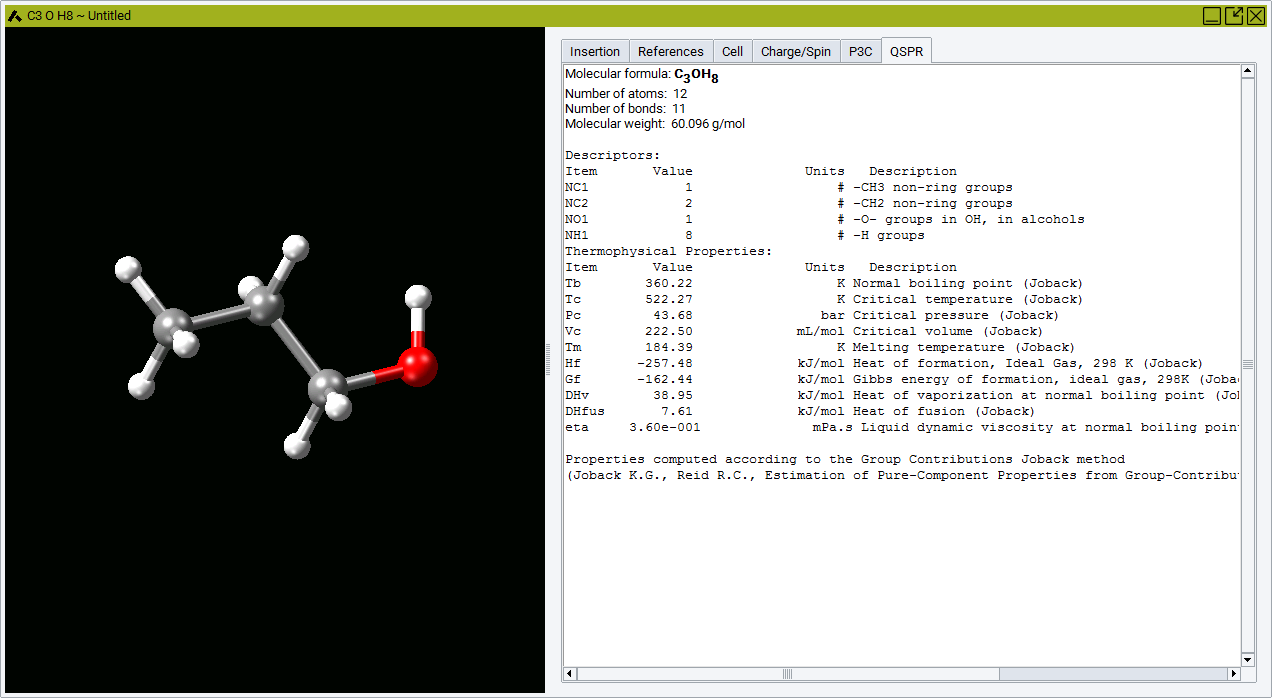
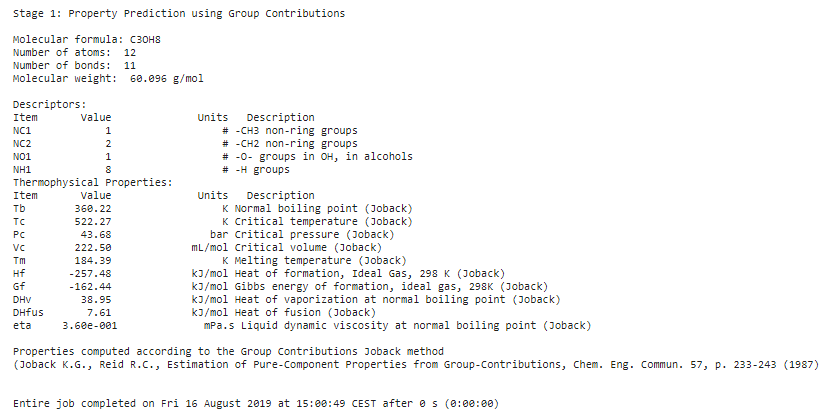
The results for propanol appear like this on the QSPR tab of the Molecular Builder and the output of a QSPR: Property Prediction using Group Contributions stage looks like this in Job.out.
| [1] | (1, 2, 3) Kevin G Joback and Robert C Reid, “Estimation of Pure-Component Properties From Group-Contributions,” Chemical Engineering Communications 57, no. 1 (February 5, 1987): 233-243. |
| download: | pdf |
|---|